
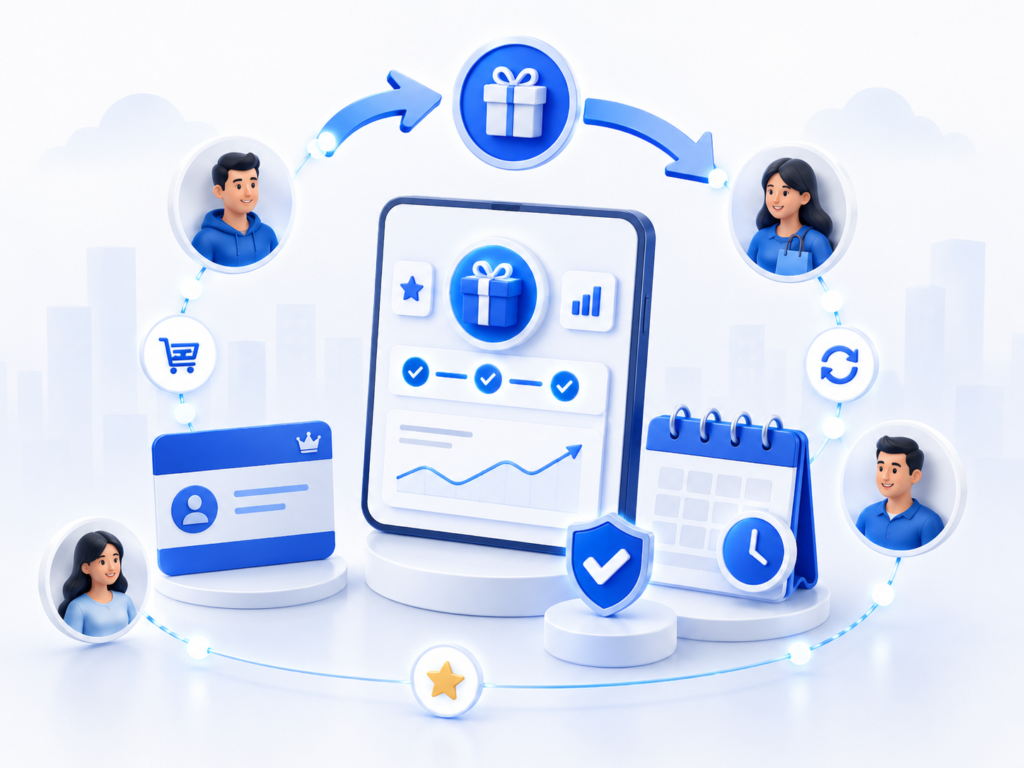
How modern businesses keep customers returning without racing to the bottom on discounts.
Most businesses are trying to solve the same problem: how do you get customers to come back after the first purchase?
For years, the answer was simple: offer a discount, send a coupon, or create a points program. Those tools can work, but they often create a weak kind of loyalty. Customers come back only when the price is lower, not because they feel connected to the brand.
That is where recurring rewards change the game.
A recurring reward is not just a one-time benefit. It is value that continues after the first transaction. It gives the customer a reason to return, check in, redeem, unlock, participate, or share. Instead of ending the relationship after the sale, the business creates a reason for the customer to stay connected.
Traditional loyalty programs often focus on transactions. A customer spends money, earns points, and maybe gets a reward later. The problem is that many customers forget the points exist. They may not understand the value, or the reward may not feel exciting enough to bring them back.
Recurring rewards work differently because they focus on continued engagement. A business can offer benefits like special access, limited perks, service credits, exclusive drops, member-only rewards, referral incentives, community access, milestone rewards, or recurring utilities tied to a purchase or membership.
The goal is simple: make the customer feel like the transaction opened a door, not ended the relationship.
This matters because customers are surrounded by options. They can buy from another store, choose another creator, book another service provider, or join another community at any time. If your business does not give them a reason to stay connected, someone else will.
Recurring rewards help solve that problem by creating ongoing value.
A strong recurring reward system should do three things:
First, it should be easy to understand. Customers should know what they unlocked, how to access it, and why it matters.
Second, it should feel useful. The reward should not feel random or low-value. It should connect to what the customer already cares about.
Third, it should be trackable. Businesses need to know what customers are claiming, redeeming, sharing, and returning for.
Kickback Contract was built around this idea. Instead of making businesses rely only on points or coupons, it helps creators, brands, and service providers create structured Kickbacks that can include rewards, utilities, verified access, buyer education, redemption tracking, and recurring value.
That means a product can become more than a product. A service can become more than a booking. A membership can become more than access. A customer action can become part of a larger value experience.
This is the new playbook: stop thinking only about the sale and start thinking about the relationship after the sale.
Businesses that understand this shift will have a major advantage. They will not just compete on price. They will compete on connection, value, access, and experience.
A discount might get someone to buy once.
A recurring reward gives them a reason to come back.
Ready to build recurring value into your business?
Explore Kickback Contract and see how Kickbacks can help you turn everyday transactions into long-term customer connection.
Want to see how the system works? Learn how Kickback Contract helps businesses create repeat engagement after the first transaction.
Learn how Kickback Contract helps businesses create repeat engagement